

NewgenONE Platform
Simplifying Complex Business Rules into Governed Decisions across Every Agent, Workflow, and Team
Define, manage, and execute complex business rules at scale. Leverage NewgenONE Business Rule Management to orchestrate consistent, compliant decisions across AI agents, workflows, and human teams. Ensure every decision is traceable, auditable, and aligned with your regulatory and business standards.

Automate Enterprise Decisions and Accelerate Workflows with AI-powered Business Rules
Leverage an AI-powered business rules management system to define and control enterprise policies and decision logic independently from application code. At scale, AI enables rapid rule creation, modification, and deployment, ensuring agility, compliance, and minimal disruption to core logic. Automate repeatable decisions, accelerate workflows, and align business strategies to maximize ROI and operational excellence across large enterprises.
Enteprise-grade Business Rules Management Capabilities of NewgenONE Platform
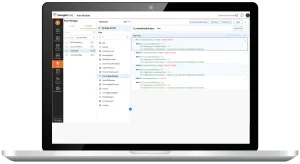
Accelerate Rule Design with AI and Pre-built Functions


Simplify Rule Management and Version Control for Large Enterprises
Maximize Efficiency with Reusable Business Rules Across Applications
Enable Rule Extensibility for Agile Business Operations
Accelerate Decision-making with AI-driven Rule Analysis and In-flight Changes
Enteprise-wide Third-party Data Integration
Accelerate Rule Design with AI and Pre-built Functions
- Create and execute simple to complex business rules using decision tables and if-else logic for precise control.
- GenAI-assisted rule flow definitions for conditional execution and faster configuration.
- Visual representation of rule flows to track execution order and dependencies easily.
- Accelerate rule design by adding new or leveraging pre-built AI-powered functions for agility and efficiency.
Simplify Rule Management and Version Control for Large Enterprises
- Customized rule conditions based on specific business needs and priorities for precise control.
- Version management of rules and rule flows for full traceability, auditability, and compliance.
Maximize Efficiency with Reusable Business Rules Across Applications
- Access out-of-the-box, industry-specific, and function-specific business rules libraries to accelerate implementation and reduce time-to-market.
- Leverage reusable rule definitions across activities, processes, and enterprise applications for consistency and efficiency.
- Expose rules and rule flows as web services for seamless integration with third-party applications and enterprise systems.
Enable Rule Extensibility for Agile Business Operations
- Fetch real-time data from database tables using dynamic picklists for improved accuracy in rule execution.
- Model and represent business decisions visually with Decision Model and Notation (DMN) for standardized, stakeholder-friendly flows.
- Enable intelligent decision-making through predictive AI models for smarter, data-driven outcomes.
Accelerate Decision-making with AI-driven Rule Analysis and In-flight Changes
- Analyze business rules before deployment using AI models to ensure logical consistency and compliance.
- Leverage GenAI for real-time rule modifications based on evolving business needs and priorities.
- Perform in-flight testing, validation, and verification of business rules for accuracy and agility.
Enteprise-wide Third-party Data Integration
- Enable enterprise-wide third-party data integration using secure web services and APIs, supporting seamless data exchange across systems.
- Integrate with multiple enterprise data sources, including MS SQL and Oracle through ODBC/JDBC connections, to ensure reliable, real-time data access for smooth customer communications.
- Support data ingestion from CSV, JSON, and XML formats, enabling flexible integration with external applications and legacy systems.
Accelerate Rule Design with AI and Pre-built Functions

- Create and execute simple to complex business rules using decision tables and if-else logic for precise control.
- GenAI-assisted rule flow definitions for conditional execution and faster configuration.
- Visual representation of rule flows to track execution order and dependencies easily.
- Accelerate rule design by adding new or leveraging pre-built AI-powered functions for agility and efficiency.
Simplify Rule Management and Version Control for Large Enterprises
- Customized rule conditions based on specific business needs and priorities for precise control.
- Version management of rules and rule flows for full traceability, auditability, and compliance.
Maximize Efficiency with Reusable Business Rules Across Applications
- Access out-of-the-box, industry-specific, and function-specific business rules libraries to accelerate implementation and reduce time-to-market.
- Leverage reusable rule definitions across activities, processes, and enterprise applications for consistency and efficiency.
- Expose rules and rule flows as web services for seamless integration with third-party applications and enterprise systems.
Enable Rule Extensibility for Agile Business Operations
- Fetch real-time data from database tables using dynamic picklists for improved accuracy in rule execution.
- Model and represent business decisions visually with Decision Model and Notation (DMN) for standardized, stakeholder-friendly flows.
- Enable intelligent decision-making through predictive AI models for smarter, data-driven outcomes.
Accelerate Decision-making with AI-driven Rule Analysis and In-flight Changes
- Analyze business rules before deployment using AI models to ensure logical consistency and compliance.
- Leverage GenAI for real-time rule modifications based on evolving business needs and priorities.
- Perform in-flight testing, validation, and verification of business rules for accuracy and agility.
Enteprise-wide Third-party Data Integration
- Enable enterprise-wide third-party data integration using secure web services and APIs, supporting seamless data exchange across systems.
- Integrate with multiple enterprise data sources, including MS SQL and Oracle through ODBC/JDBC connections, to ensure reliable, real-time data access for smooth customer communications.
- Support data ingestion from CSV, JSON, and XML formats, enabling flexible integration with external applications and legacy systems.
Lead with an Industry-recognized Platform


Customers


Customers






Customers


Customers




Customers







Customers
Customers


Intelligent Process Automation Capabilities of NewgenONE Platform









All You need to know about Business Rules Management (BRM)
Business Rules Management (BRM) is the process of managing and automating the business rules used to make decisions in an organization. Business rules are specific guidelines or criterias that help an organization make decisions on how to operate or how to respond to certain situations. For example, a rule might dictate that a customer must be notified if their payment is overdue by more than 30 days. By using BRM, organizations can store and manage their business rules in a centralized system, making it easier to ensure consistency and accuracy in the decision-making process.
A Business Rules Engine (BRE) is a software tool that is used to define, manage and execute business rules within an organization.
It is a statement that defines a specific aspect of the business and how it should operate. These rules can be used to automate decision-making processes, validate business transactions, and enforce business policies.
For example, a business rule might define how a customer’s credit rating is determined.
BREs are designed to be flexible and easily configurable so that business users can modify the rules without requiring assistance from IT staff. This allows the rules to be updated quickly in response to changes in the business environment.
It also enables non-technical users to manage and update the rules, which can be useful for organizations that have a lot of rules or need to modify them frequently.
BREs can be integrated into a wide range of applications, such as customer relationship management systems, enterprise resource planning systems, and financial systems.
Once the business rules are defined, the BRE evaluates the rules against the data that it receives, and takes appropriate action based on the outcome of the evaluation. This can include sending an alert, initiating a workflow, or updating a database. The BRE can also provide feedback on the results of the rule evaluation, which can be used to analyze and improve business processes.
In the context of insurance, businesses could leverage a BRE to automate the decision-making process for insurance claims processing. The rule engine would be programmed with the company’s business rules and policies, such as coverage limits, deductibles, and eligibility criteria. When a new insurance claim is submitted, the BRE would analyze the data provided in the claim form and determine the appropriate action to be taken based on the business rules and policies.
A Business Rules Management System (BRMS) offers several benefits to organizations:
- Centralized Rule Management: BRMSs provide a centralized platform for creating, storing, and managing business rules. This ensures consistency and eliminates redundancy across different applications and systems.
- Scalability: BRMSs allow organizations to scale their business rules as needed, accommodating changes in business processes, regulations, and market conditions without requiring significant manual effort.
- Agility and Flexibility: BRMSs enable rapid adaptation to changing business requirements by separating business rules from application code. This allows organizations to modify rules quickly and deploy them without disrupting existing systems.
- Improved Compliance: BRMSs help ensure regulatory compliance by enforcing consistent application of rules across the enterprise. They also provide auditing and reporting capabilities to track rule changes and demonstrate compliance to regulatory authorities.
- Enhanced Operational Efficiency: By automating decision-making based on predefined rules, BRMSs streamline business processes, reduce manual errors, and improve operational efficiency.
- Empowered Business Users: BRMSs empower business users and domain experts to define and manage business rules without extensive IT involvement. This democratization of rule management speeds up decision-making and enhances agility.
- Increased Consistency and Accuracy: BRMSs enforce consistent application of rules across systems, reducing the risk of errors and inconsistencies in decision-making. This leads to improved data quality and reliability.
- Cost Savings: BRMSs can lead to cost savings by reducing the time and effort required for manual rule implementation, maintenance, and updates. They also contribute to faster time-to-market for new products or services.
Overall, a Business Rules Management System (BRMS) helps organizations achieve greater agility, compliance, efficiency, and cost-effectiveness in managing and implementing business rules across the enterprise.
Orchestrate for an Intelligent Enterprise, Now!
Explore all the ways you can tap into orchestration to transform your business for the era of intelligence!
