NewgenONE Platform
AI-first Model Development Studio
Leverage an intuitive, enterprise-grade drag-and-drop design studio for consistent model development.

Streamline the end-to-end data science lifecycle using an intelligent, intuitive drag-and-drop interface for rapid model development, experimentation, and continuous refinement. Leverage advanced built-in modeling algorithms to develop and deploy models on large-scale datasets with consistency and speed. Evaluate model performance through visual, metric-driven reports, enabling teams to compare, optimize, and select the best-fit models with confidence.
Enterprise- grade AI Model Development Capabilities of NewgenONE Platform
Profile Your Data for Completion, Accuracy, and Validity


Utilize Rich Modeling Algorithms and Techniques
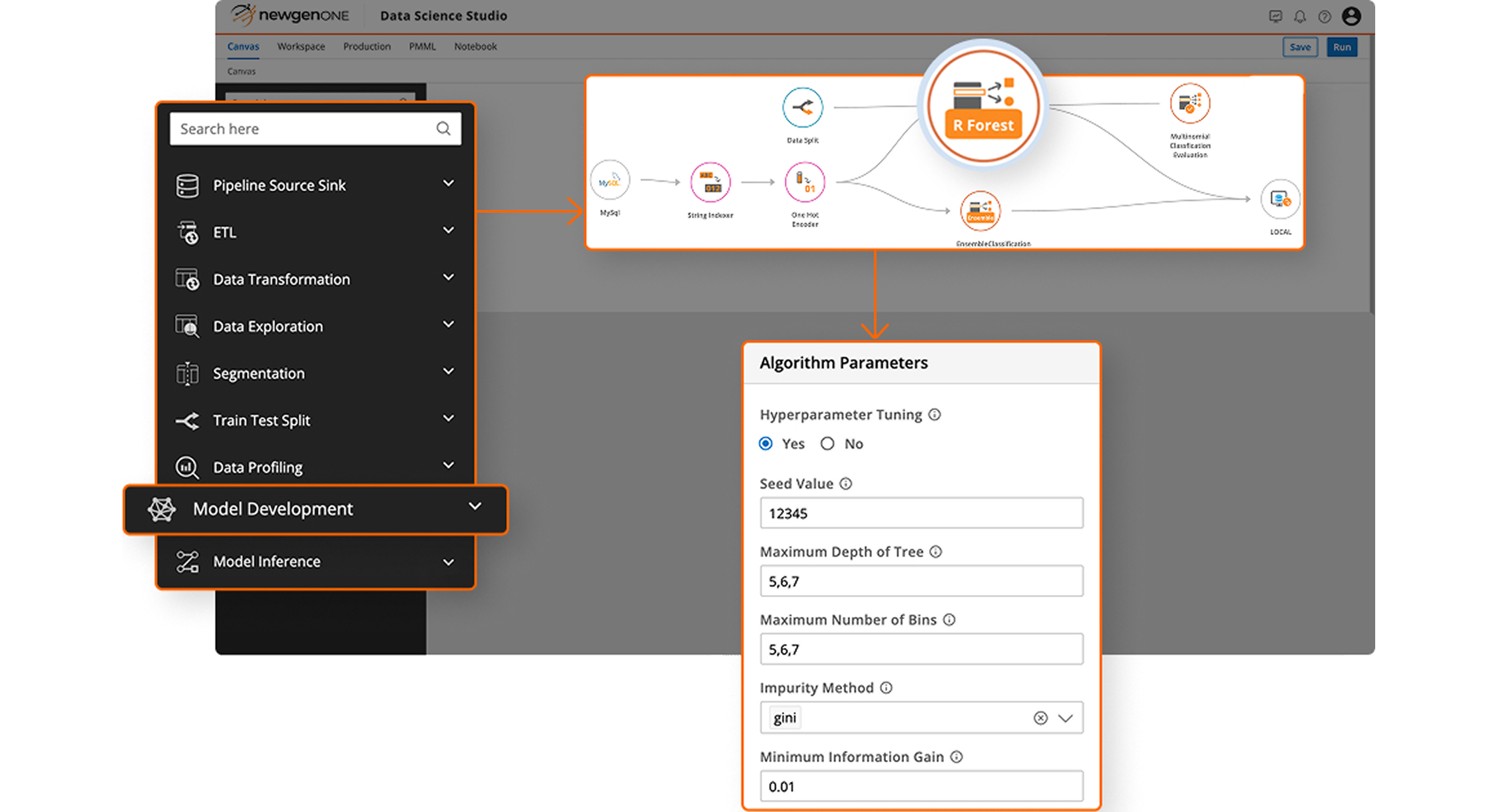
Design the Model Pipeline Visually
Engineer Features for Supervised and Unsupervised Learning
Access In-built Segmentation Operations
Evaluate Models in Detail
Leverage AI as a Glass Box
Profile Your Data for Completion, Accuracy, and Validity
- Perform data profiling operations on structured and unstructured data, such as one-hot encoding, stemming, lemmatization, missing value imputation, and count vectorizer, etc.
- Use built-in machine learning (ML) and deep learning-based techniques for dimensionality reduction, including singular value decomposition (SVD), principal component analysis (PCA), and restricted Boltzmann machine (RBM)
Utilize Rich Modeling Algorithms and Techniques
- Use multiple options to model, including graph, ML, deep learning, and natural language processing
- Perform model averaging techniques—stacking and ensembling
- Develop models on massive-scale datasets by utilizing the in-memory distributed computing-based processing
Design the Model Pipeline Visually
- Perform rapid model experimentation, development, and evolution through the visually intuitive drag-and-drop interface
- Configure each node and drop it on the canvas with others to build your own model pipeline
Engineer Features for Supervised and Unsupervised Learning
- Create and define your own features, based on separate boolean and aggregate operations with comprehensive feature engineering
- Use the coding interface or the visual workflow editor to create new data columns
Access In-built Segmentation Operations
- Create segments on both numeric and textual data
- Create user-defined rules and conditions for segment creation
- Make use of both macro and micro-level segmentation
Evaluate Models in Detail
- Select the best models based on several visual performance metric reports
- Evaluate the model performance using the rich set of evaluation metrics
- Use multiple modeling techniques on the same feature engineered data with multi-model experimentation and evaluation
Leverage AI as a Glass Box
- Access and configure all the modeling parameters
- Fetch a detailed ‘feature importance report,’ explaining the output
Profile Your Data for Completion, Accuracy, and Validity

- Perform data profiling operations on structured and unstructured data, such as one-hot encoding, stemming, lemmatization, missing value imputation, and count vectorizer, etc.
- Use built-in machine learning (ML) and deep learning-based techniques for dimensionality reduction, including singular value decomposition (SVD), principal component analysis (PCA), and restricted Boltzmann machine (RBM)
Utilize Rich Modeling Algorithms and Techniques
- Use multiple options to model, including graph, ML, deep learning, and natural language processing
- Perform model averaging techniques—stacking and ensembling
- Develop models on massive-scale datasets by utilizing the in-memory distributed computing-based processing
Design the Model Pipeline Visually
- Perform rapid model experimentation, development, and evolution through the visually intuitive drag-and-drop interface
- Configure each node and drop it on the canvas with others to build your own model pipeline
Engineer Features for Supervised and Unsupervised Learning
- Create and define your own features, based on separate boolean and aggregate operations with comprehensive feature engineering
- Use the coding interface or the visual workflow editor to create new data columns
Access In-built Segmentation Operations
- Create segments on both numeric and textual data
- Create user-defined rules and conditions for segment creation
- Make use of both macro and micro-level segmentation
Evaluate Models in Detail
- Select the best models based on several visual performance metric reports
- Evaluate the model performance using the rich set of evaluation metrics
- Use multiple modeling techniques on the same feature engineered data with multi-model experimentation and evaluation
Leverage AI as a Glass Box
- Access and configure all the modeling parameters
- Fetch a detailed ‘feature importance report,’ explaining the output