NewgenONE Platform
AI-first Communication Generation for Large Enterprises
Generate personalized, responsive customer communications in real time or at scale, using AI-powered enterprise data and rules to ensure accuracy, consistency, and governance across all outputs.

How is Enterprise-grade Communication Generation Managed Across Batch and Real-time Modes?
The AI-powered platform enables enterprises to generate highly personalized communications across batch, on-demand, and interactive modes, supporting both large-scale operational cycles and immediate customer interactions. Job-based generation and scheduling allow organizations to plan and execute communication output in line with customer preferences, regulatory timelines, and business SLAs, improving operational efficiency and control. Real-time communication generation, powered by a centralized template repository and direct integration with enterprise applications and systems, ensures consistency, accuracy, and governance.
What Are the Enterprise Communication Generation Capabilities of the NewgenONE Platform?
Intelligent Communication Generation for Real-time and Ad-hoc Scenarios


AI-enabled Personalized Correspondence
Advanced Communication Scheduling and Monitoring
No-code Communication Generation Environment
AI-assisted Reporting and Governed Collaboration
Data Integration from Multiple Enterprise Sources
Intelligent Communication Generation for Real-time and Ad-hoc Scenarios
- AI-led Real-time communication generation with access to customer information, enabling enterprises to act on live business events and customer interactions with greater speed, accuracy, and relevance
- Intelligent Ad-hoc communication generation from websites, mobile, or business applications, allowing business and operations teams to issue context-aware communications when needed, improving operational agility and customer responsiveness.
AI-enabled Personalized Correspondence
- Relevant, targeted communications generated from customer profiles, enabling enterprises to deliver personalized correspondence that reflects customer context while improving engagement quality and reducing manual personalization effort at scale
- Interactive editor with controlled, permission-based editing, allowing authorized users to tailor one-to-one communications while preserving content integrity, governance, and compliance across enterprise workflows.
Advanced Communication Scheduling and Monitoring
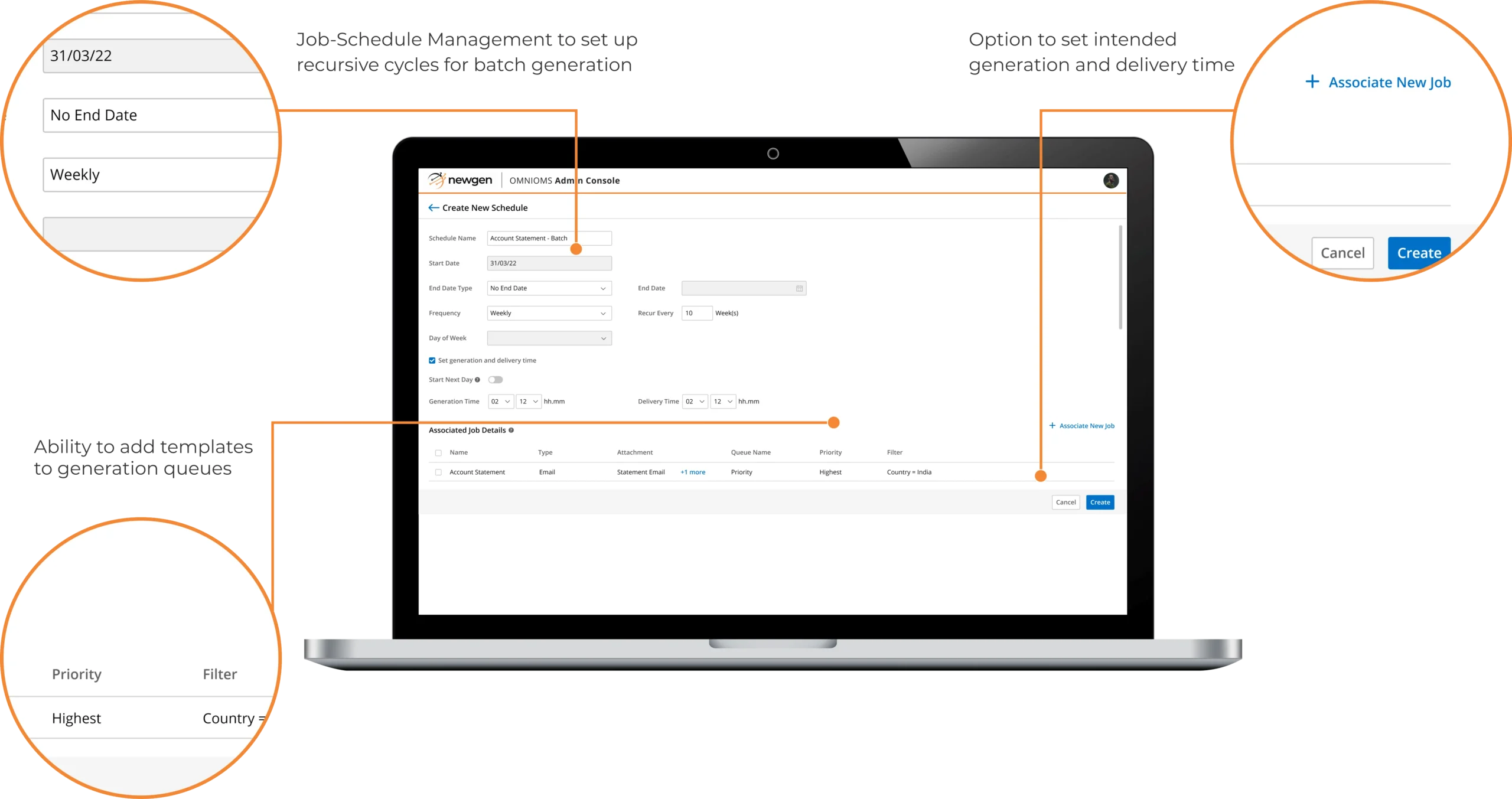
- Job-based output scheduling for communications such as bills, financial statements, and policies, enabling predictable execution aligned with business calendars and SLAs, strengthening operational reliability across high-volume communication cycles.
- Controlled, permission-based editing during scheduled generation, reducing manual intervention and errors to drive risk reduction while enforcing governance at scale across critical communication outputs.
No-code Communication Generation Environment
- User-friendly, no-coding document generation environment, enabling business teams to configure and manage communication outputs independently, improving enterprise-grade operational reliability
- Automatic sorting and bundling of generated documents, optimizing output organization and delivery while driving risk reduction through standardized processing
AI-assisted Reporting and Governed Collaboration
- Real-time status monitoring through detailed operational reports, giving enterprises continuous visibility into communication generation progress
- Concurrent collaboration for reviews and approvals, allowing multiple stakeholders to work in parallel while maintaining controlled workflows, driving risk reduction
Data Integration from Multiple Enterprise Sources
- Integration with a centralized template gallery and multiple business applications, ensuring consistent communication structure and content reuse, which improves enteprise-wide operational reliability
- Core systems integration for automatic data population from enterprise systems, enabling accurate, real-time data usage in communications
Intelligent Communication Generation for Real-time and Ad-hoc Scenarios

- AI-led Real-time communication generation with access to customer information, enabling enterprises to act on live business events and customer interactions with greater speed, accuracy, and relevance
- Intelligent Ad-hoc communication generation from websites, mobile, or business applications, allowing business and operations teams to issue context-aware communications when needed, improving operational agility and customer responsiveness.
AI-enabled Personalized Correspondence
- Relevant, targeted communications generated from customer profiles, enabling enterprises to deliver personalized correspondence that reflects customer context while improving engagement quality and reducing manual personalization effort at scale
- Interactive editor with controlled, permission-based editing, allowing authorized users to tailor one-to-one communications while preserving content integrity, governance, and compliance across enterprise workflows.
Advanced Communication Scheduling and Monitoring
- Job-based output scheduling for communications such as bills, financial statements, and policies, enabling predictable execution aligned with business calendars and SLAs, strengthening operational reliability across high-volume communication cycles.
- Controlled, permission-based editing during scheduled generation, reducing manual intervention and errors to drive risk reduction while enforcing governance at scale across critical communication outputs.
No-code Communication Generation Environment
- User-friendly, no-coding document generation environment, enabling business teams to configure and manage communication outputs independently, improving enterprise-grade operational reliability
- Automatic sorting and bundling of generated documents, optimizing output organization and delivery while driving risk reduction through standardized processing
AI-assisted Reporting and Governed Collaboration
- Real-time status monitoring through detailed operational reports, giving enterprises continuous visibility into communication generation progress
- Concurrent collaboration for reviews and approvals, allowing multiple stakeholders to work in parallel while maintaining controlled workflows, driving risk reduction
Data Integration from Multiple Enterprise Sources
- Integration with a centralized template gallery and multiple business applications, ensuring consistent communication structure and content reuse, which improves enteprise-wide operational reliability
- Core systems integration for automatic data population from enterprise systems, enabling accurate, real-time data usage in communications