NewgenONE Platform
AI-first Data Model Designer
Leverage AI-driven master data management to ensure enterprise-wide consistency, governance, and standardization across systems. Centrally manage trusted data foundations to power accurate insights, regulatory confidence, and informed decision-making at global scale.

How does AI-driven master data management ensure enterprise-wide data consistency and governance?
Establish consistent, trusted data foundations across channels, applications, and third-party systems through AI-assisted master data management. Enable users to create, manage, and retire master data tables aligned to specific business requirements—without compromising governance or control. With centralized data management and policy-driven governance, organizations can standardize critical enterprise data, enforce compliance across the organization, and unlock accurate, actionable insights that support informed decision-making at scale.
AI-first Data Model Design for Enterprise-scale Governance on NewgenONE
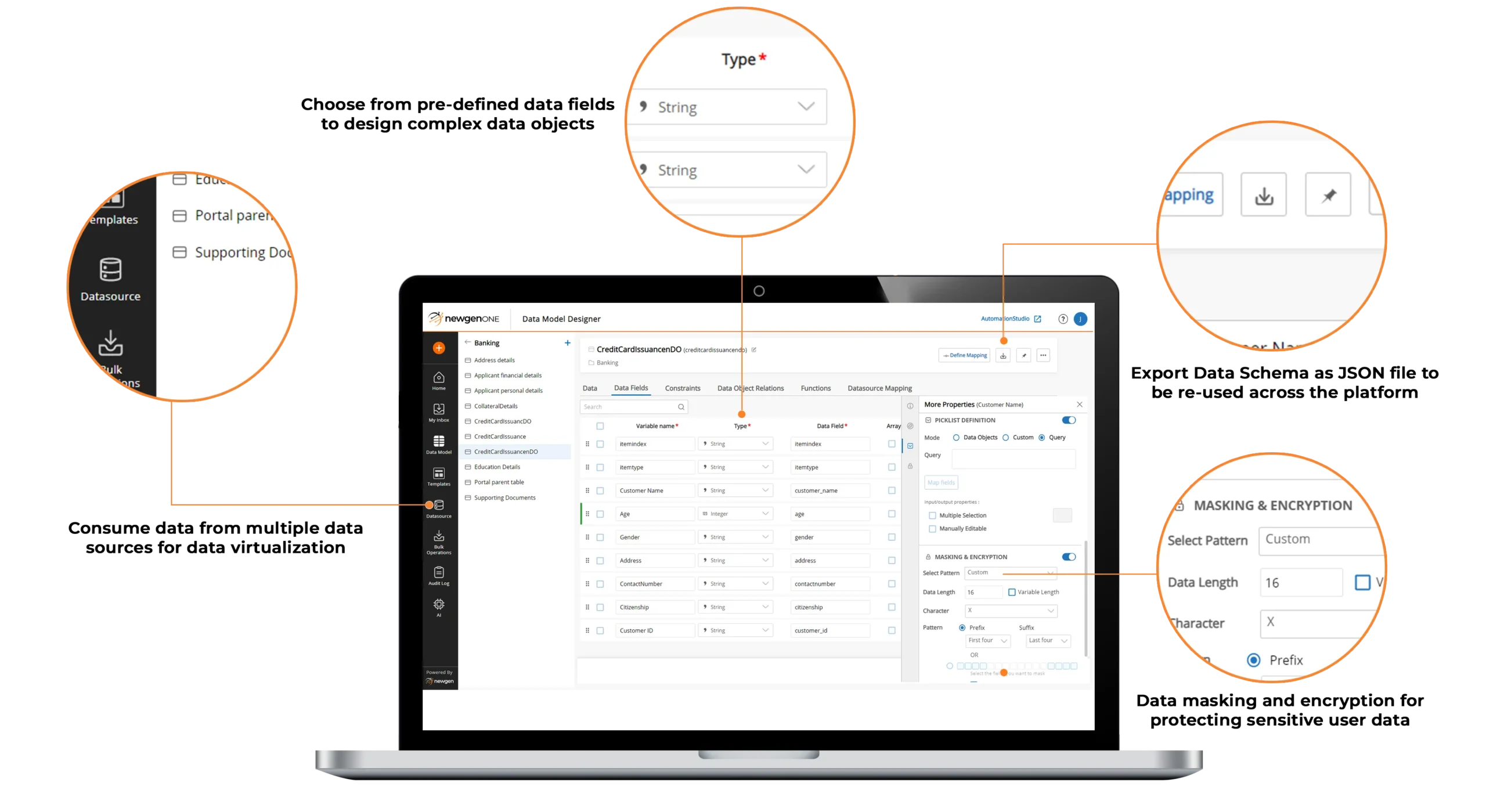
AI-driven Visual Data Modeling and Management


Enterprise-wide Data Virtualization and Synchronization
Intelligent Data Object Reusability
Enterprise-grade Data Security and Encryption
AI-driven Visual Data Modeling and Management
- Design and manage data models using a visual, low-code interface with guided, wizard-based workflows, reducing complexity and development effort
- Accelerate model creation with prebuilt enterprise data types such as currency, phone number, and binary formats
- Visualize complex data structures using entity relationship (ER) diagrams for improved clarity, validation, and impact analysis
- Enforce accuracy and consistency through multi-level approval workflows for master data updates, reducing errors and strengthening governance
Enterprise-wide Data Virtualization and Synchronization
- Establish a single, logical source of truth by accessing data from multiple applications, core systems, and third-party sources through a unified interface
- Leverage out-of-the-box connectors to integrate with databases such as MySQL, SQL Server, PostgreSQL, Oracle, and more
- Perform advanced joins, transformations, and arithmetic operations to fetch, filter, and organize external data efficiently
- Enable real-time and scheduled data synchronization to improve responsiveness and ensure data freshness across applications
Intelligent Data Object Reusability
- Import data objects from external systems using Excel and JSON formats to accelerate data model creation
- Define reusable data object templates to ensure consistency, accuracy, and standardization across portals and processes
- Export data objects and structures for reuse across applications and environments
- Decouple logical data definitions from physical data sources, enabling flexible reuse without redesigning data models
Enterprise-grade Data Security and Encryption
- Apply field-level controls by marking data attributes as read-only, mandatory, or unique to maintain integrity
- Protect sensitive information using built-in data masking and encryption, aligned with enterprise security standards
- Maintain detailed audit logs to monitor access, detect anomalies, support compliance, and investigate security or performance issues
AI-driven Visual Data Modeling and Management

- Design and manage data models using a visual, low-code interface with guided, wizard-based workflows, reducing complexity and development effort
- Accelerate model creation with prebuilt enterprise data types such as currency, phone number, and binary formats
- Visualize complex data structures using entity relationship (ER) diagrams for improved clarity, validation, and impact analysis
- Enforce accuracy and consistency through multi-level approval workflows for master data updates, reducing errors and strengthening governance
Enterprise-wide Data Virtualization and Synchronization
- Establish a single, logical source of truth by accessing data from multiple applications, core systems, and third-party sources through a unified interface
- Leverage out-of-the-box connectors to integrate with databases such as MySQL, SQL Server, PostgreSQL, Oracle, and more
- Perform advanced joins, transformations, and arithmetic operations to fetch, filter, and organize external data efficiently
- Enable real-time and scheduled data synchronization to improve responsiveness and ensure data freshness across applications
Intelligent Data Object Reusability
- Import data objects from external systems using Excel and JSON formats to accelerate data model creation
- Define reusable data object templates to ensure consistency, accuracy, and standardization across portals and processes
- Export data objects and structures for reuse across applications and environments
- Decouple logical data definitions from physical data sources, enabling flexible reuse without redesigning data models
Enterprise-grade Data Security and Encryption
- Apply field-level controls by marking data attributes as read-only, mandatory, or unique to maintain integrity
- Protect sensitive information using built-in data masking and encryption, aligned with enterprise security standards
- Maintain detailed audit logs to monitor access, detect anomalies, support compliance, and investigate security or performance issues