


Connect with us on LinkedIn
Newgen Software is a globally recognized provider of Low Code Digital Transformation Platform
 Connect On LinkedIn
Change is Measured in Moments, Not Years
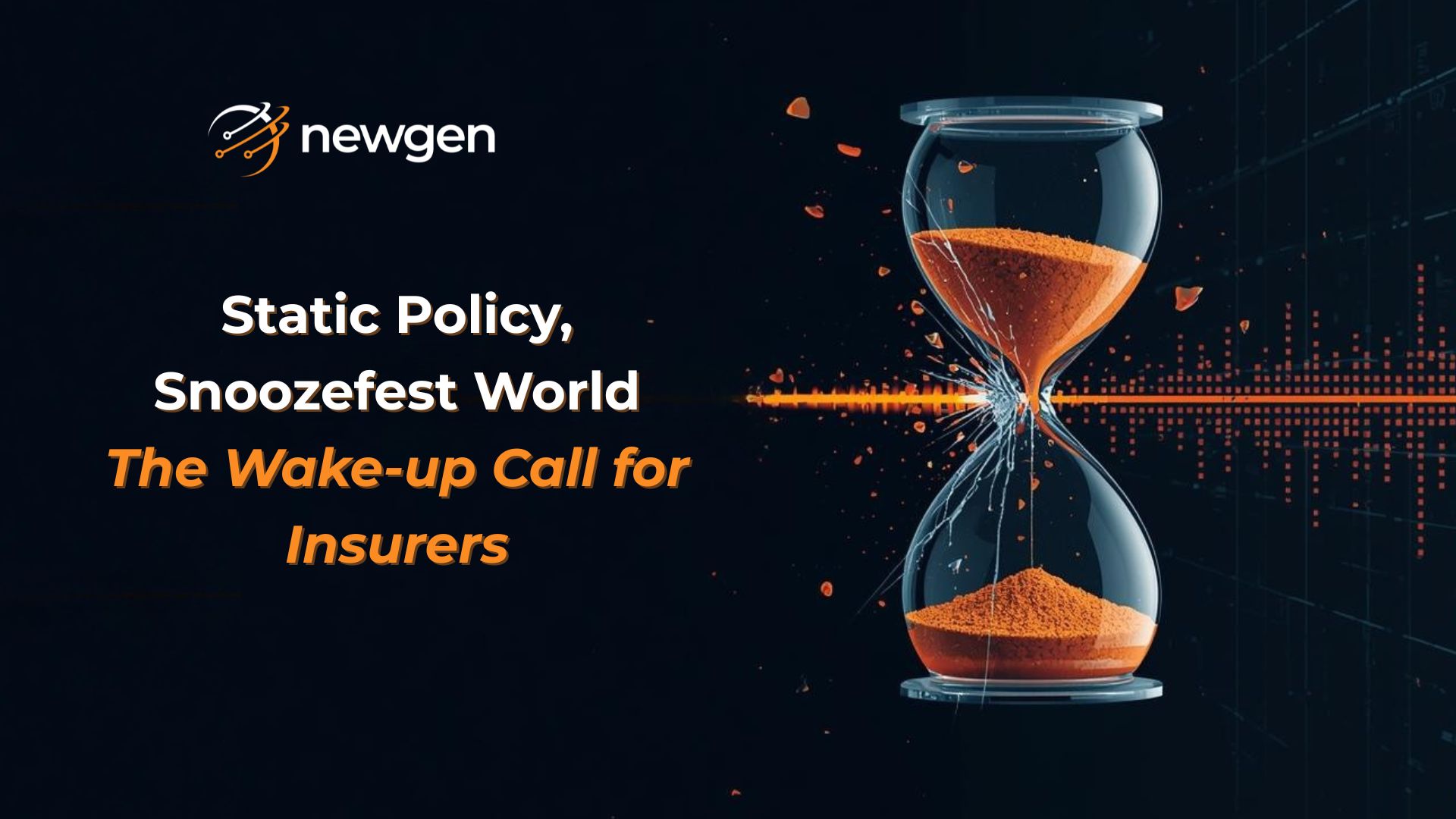
The insurance industry rested on a century-old foundation of stability. Policies worked like time capsules, signed once and forgotten for a year. This model worked when change was slow and data was limited.
Today’s world moves in real-time. Risks no longer shift gradually; things can change overnight. In fact, Swiss Re reported that global economic losses from natural catastrophes exceeded USD 280 billion in recent years, with loss patterns shifting within seasons rather than across years. At the same time, mobility behavior, cyber exposure, and business operations fluctuate daily and sometimes hourly. Yet, most insurance products continue to behave like long-term contract, increasingly out of sync with the dynamic world it aims to protect.
The Shift from Disconnected to Dynamic
This disconnect signals a pivotal phase. Incremental digital updates are no longer sufficient. To stay relevant, insurance operations must be redesigned to drive hyper-personalization. This transformation is driven in the concept of the living policy, enabled by customization at the individual level (N = 1), Agentic AI, and a modernized technology core.
Static Contracts in a Dynamic World
Traditional insurance looks backward. It relies on past data to guess future risk, then locks that guess into a fixed, year-long contract. However, new-age customers demand responsiveness and relevance. While traditional models struggle to keep pace, new data streams offer a powerful opportunity to deliver better value. The opportunity lies in insurers’ ability to act on the available data.
Industry data revealed a telling paradox. While most insurance executives are optimistic about AI’s power to transform underwriting, only a small fraction of insurers operationalized it to make faster, informed decisions. This lag creates a persistent mismatch. A customer’s actual exposure can change in real-time, while their coverage remains locked in place. Whether a fleet scales down operations or a customer takes preventive action, underwriting, claims, and servicing workflows are often frozen until renewal.
Redesigning Policy for a World of Continuous Risk
A living policy operates differently. It’s not a snapshot frozen in time, but a living stream of coverage that constantly recalibrates to evolving reality. This principle is built on three core characteristics including:
1. Dynamic coverage and pricing
2. Continuous risk assessment
3. Modular policy components triggered by context
This shifts insurance from a once-a-year product into continuously responsive service. Claims become integrated moments within an ongoing risk journey, enabling early detection, signals, proactive support, and faster more personalized resolutions.
Hyper-personalization by Design
Hyper-personalization moves insurance beyond broad actuarial averages, allowing it to mirror an individual’s actual behavior in real time. This is powered by the integration of data from telematics, IoT devices, and enterprise systems, enabling the continuous refinement of risk profiles. The model unlocks some tangible value through examples like:
- An auto premium that adapts monthly to reflect verifiably safer driving habits
- A commercial policy where premiums and coverage automatically flex with a company’s daily operational scale
- A home insurance model that transitions from simple monitoring to true risk prevention, offering proactive guidance based on real-time sensor data
Agentic AI as the Engine of Continuous Action
Agentic AI works like a smart assistant, independently monitoring situations, deciding on the next step, and taking action, always within a safe, approved framework.
It connects every part of the insurance process, from setting up a policy to settling claims, so everything works in sync and smoothly together as one system. Furthermore, it can:
- Update a customer‘s coverage and pricing in real time, based on what’s actual activity and risks
- Sort through claims quickly to decide which ones need attention first, expediting resolution
- Contact customers with critical updates and support during high-impact events like a storm or after a car accident
- Make different teams and systems work together seamlessly, breaking down operational silos
Hollowing Out the Core to Enable Agility
The greatest constraint on adaptive insurance is architectural, not data or intelligence. Many insurers still rely on legacy core systems built for stability, not speed. According to a report, over 70% of insurers’ annual IT budgets are spent on maintaining existing systems, limiting investment on innovation and responsiveness. The path forward is to decouple and modernize key functions, moving them away from the monolithic legacy systems. This involves separating product logic, business rules, decisioning and orchestration, and customer communication into agile, independent layers.
Navigating Regulatory and Trust Challenges
As insurance becomes maore adaptive, trust becomes foundational. Customers must understand why decisions are made and how data is used. Industry leaders emphasize that responsible AI adoption requires:
- Built-in security and privacy
- Transparent decision logic
- Clear governance and auditability
Driving the Shift with Newgen
True adaptive insurance mandates more than new technology, it demands a new way of operating.
Newgen drives that change. Our AI-first, low-code platform gives insurers the power to break free from legacy systems, modernizing workflows, decisioning, and communication in one move. By leveraging our agentic automation, you can stay compliant and enable:
- Continuous, real-time underwriting
- Dynamic claims management handling
- Adaptive, personalized customer service
We orchestrate the entire journey, from policy to claim to engagement, turning static administration into lifelong protection.
The future is adaptive. Let’s build it together. See what Newgen can do.
You might be interested in