Key takeaway: In 2027, healthcare operations shift from digital tools to connected work. Seven trends (interoperability that triggers action, agentic AI judged by completed work, automation measured by net ROI, connected patient and member experience, care beyond hospital walls, operational AI governance, and defensible regulated intelligence) show US payers, providers, and life sciences organizations how to reduce administrative work and return time to care.
What Will Define Healthcare Transformation in 2027?
In 2027, healthcare transformation will be defined by connected operations: interoperable data that triggers the next workflow step, governed AI agents that complete administrative work, and automation measured by net return on investment (ROI). In a February 2026 Deloitte survey of 100 US healthcare technology executives, 61% reported building or implementing agentic AI initiatives or having secured funding, and 85% planned to increase investment over the following two to three years.
Healthcare organizations have invested heavily in digital transformation, automation, and artificial intelligence (AI). Yet US health plans, providers, and life sciences organizations continue to face challenges due to disconnected systems, rising administrative cost, and sub-par patient experiences. In 2027, success will depend on how effectively they turn technology investments into connected operations and measurable improvements.
AI will play a greater role in healthcare, but adopting new tools alone will not be enough. Organizations must connect information, people, processes, and decisions to reduce administrative work, improve efficiency, and give healthcare professionals more time for patient care. Leaders should prioritize connected data and workflows, governed agentic AI, measurable automation outcomes, and coordination across care settings.
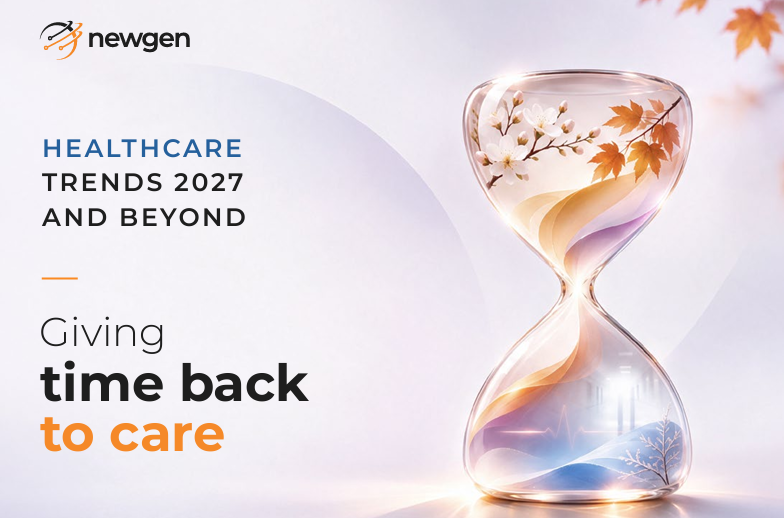
Newgen’s Healthcare Trends 2027 and Beyond report explores seven important shifts, from actionable interoperability and governed agentic AI to measurable automation ROI, connected care delivery, and stronger regulatory accountability.
What Will You Explore in Healthcare Trends 2027?
- How healthcare interoperability is moving beyond data exchange to coordinated action
- Why agentic AI must complete meaningful work, not just automate individual tasks
- How healthcare organizations can demonstrate measurable ROI from automation
- What it takes to improve patient and member experiences beyond digital channels
- Why care delivered outside hospitals requires connected operations
- How healthcare leaders can establish stronger AI governance and accountability
- What responsible AI adoption means for regulated pharmaceutical and life sciences operations
Seven Healthcare Trends Shaping the Future of Care
Newgen’s report identifies seven trends that will shape healthcare operations in 2027 and beyond:
- Interoperability must move from exchange to action
- Agentic AI will be judged by the work it completes
- The administrative cost squeeze: automation must finally prove its ROI
- Experience will be won behind the digital front door
- Care without walls will need connected operations
- Enterprise AI governance will make accountability operational
- Regulated intelligence will need evidence that stands up to review
Discover the trends, emerging priorities, and practical opportunities that can help healthcare organizations reduce administrative complexity, improve operational performance, and give more time back to care.
What are the key healthcare technology trends for 2027?
+
−
The seven key healthcare trends for 2027 are interoperability that moves from exchange to action, agentic AI judged by the work it completes, the administrative cost squeeze and automation ROI, experience behind the digital front door, care without walls, enterprise AI governance, and regulated intelligence. These trends reflect a growing focus on reducing administrative costs, improving operational coordination, and giving healthcare professionals more time for patient care.
How will AI transform healthcare operations in 2027?
+
−
Agentic AI in healthcare is software that completes linked administrative work across applications within defined permissions. In 2027, AI in healthcare moves beyond generating insights and automating isolated tasks to completing connected administrative activities. AI agents can help collect records, validate information, prepare prior authorization cases, and coordinate follow-ups across systems. These activities must operate within defined permissions, with audit trails, escalation rules, and human oversight for clinical and other consequential decisions.
Why is healthcare interoperability important in 2027?
+
−
Healthcare interoperability enables health plans and providers to securely exchange and use patient, clinical, and coverage information across systems. In 2027, the focus will increasingly shift from data exchange to making that information actionable within workflows. The Centers for Medicare & Medicaid Services (CMS) Interoperability and Prior Authorization final rule (CMS-0057-F) includes application programming interface (API) implementation milestones generally beginning in 2027 for affected US payers. Connected workflows can help reduce manual handoffs, repeated requests, and delays in decision-making.
How can healthcare organizations measure the ROI of automation?
+
−
Healthcare organizations can measure automation ROI by tracking cost per resolved case, end-to-end processing time, error rates, rework, and staff capacity released. For payers, this may include claims processing and prior authorization efficiency. Providers may measure revenue cycle performance and time saved on documentation. Net ROI must also account for technology, integration, monitoring, and exception-handling costs rather than simply counting automated tasks. Deloitte’s 2026 US Healthcare CFO Survey found that nearly 60% of surveyed CFOs were targeting margin improvements of at least two percentage points over the next two years.
How will patient and member experiences change in 2027?
+
−
Patient and member experience improvements will depend on connecting digital interactions with the operational systems that resolve requests. Healthcare organizations will need to integrate scheduling, eligibility verification, authorizations, billing, and follow-up into coordinated journeys. This can reduce repeated calls, eliminate unnecessary paperwork, and improve first-contact resolution while maintaining access to human support when needed.
What does care without walls mean for healthcare organizations?
+
−
Care without walls refers to healthcare services delivered beyond traditional hospital settings, including patients’ homes, pharmacies, virtual care, and community-based locations. Supporting these services requires connected referrals, authorizations, monitoring, care coordination, and escalation processes. Health plans and providers must also track clinical outcomes, patient experiences, and costs across the full episode of care to determine whether these models are effective and sustainable. EY’s 2026 US Consumer Health Survey found that 55% of US respondents tracked health data, while only 34% said their doctors had access to and actively used wearable data.
What is enterprise AI governance in healthcare?
+
−
Enterprise AI governance is the framework of policies, controls, responsibilities, and oversight used to manage AI across healthcare operations. It includes approved data access, risk-based reviews, performance monitoring, audit trails, and clearly defined human decision-making authority. For US health plans and providers, stronger governance helps ensure that AI used in coverage, payment, and clinical workflows remains accountable, safe, and aligned with applicable regulatory requirements.
How will AI affect pharmaceutical and life sciences operations in 2027?
+
−
AI can help pharmaceutical and life sciences organizations improve clinical documentation, safety case processing, evidence assembly, and regulatory submission workflows. However, AI-supported work must remain scientifically reliable and traceable. Organizations need validated processes, controlled document versions, reproducible evidence, and documented scientific review to meet applicable regulatory expectations, including those of the US Food and Drug Administration (FDA). In January 2026, the FDA and the European Medicines Agency published ten joint guiding principles for good AI practice in drug development, which sit alongside binding US requirements.
What should healthcare leaders prioritize for digital transformation in 2027?
+
−
Healthcare leaders should prioritize connected data and workflows, governed agentic AI, measurable automation outcomes, and improved coordination across care settings. They must establish clear accountability for AI-supported activities and measure improvements across complete processes rather than isolated tasks. The goal is to reduce administrative burden while protecting care quality, regulatory compliance, and operational efficiency.
Who should read the Healthcare Trends 2027 report?
+
−
The report is designed for US healthcare leaders and decision-makers across health plans, healthcare providers, pharmaceutical companies, and life sciences organizations. It is particularly relevant to executives responsible for technology, operations, digital transformation, patient and member experience, revenue cycle management, AI governance, and regulatory compliance.