AI is moving closer to insurance decisions. Is your operating model ready?
Insurance transformation is entering a decisive phase. AI is moving beyond isolated experiments to influence how insurers acquire customers, assess risk, underwrite policies, manage claims, and deliver service. According to KPMG’s 2025 Insurance CEO Outlook, 73% of insurance CEOs identify AI as a top investment priority. Yet, the real challenge lies in translating these investments into measurable business outcomes while maintaining trust, governance, and human oversight.
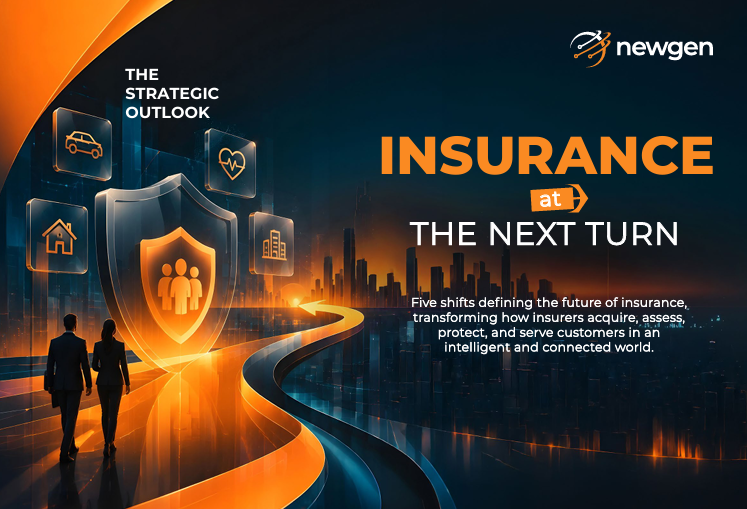
Newgen’s Insurance at the Next Turn report explores five strategic shifts shaping insurance operations in 2027 and beyond.
- Smart Customer Onboarding: Recognize customer intent earlier, personalize product discovery, and orchestrate next-best actions across channels
- Continuous Risk Intelligence: Combine dynamic risk signals, contextual evidence, and decision intelligence for more informed risk assessments
- Exception-led Underwriting & Payment Integrity: Accelerate routine processing while prioritizing complex cases, anomalies, and potential fraud
- Claims at First Signal: Use multimodal evidence, intelligent intake, and automated routing to reduce claims friction
- Event-led Servicing: Anticipate customer needs through life events, policy milestones, and risk signals to strengthen engagement and retention
Explore how insurers can connect information, workflows, decisions, and AI to build intelligent operations. Explore regional priorities, emerging operating models, and the business metrics, from conversion and decision speed to claims efficiency and customer retention.
Frequently Asked Questions
Five trends are shaping insurance transformation, including smart customer onboarding, continuous risk intelligence, exception-led underwriting and payment integrity, claims at first signal, and event-led servicing. Together, they support more connected, intelligent, and measurable insurance operations.
AI will help insurers recognize customer needs, assess risks, automate routine decisions, process claims evidence, and deliver proactive service. Human oversight will remain essential for complex, sensitive, and high-impact decisions.
Continuous risk intelligence combines structured data, documents, historical evidence, and permitted risk signals to support more current, explainable risk assessments. It helps insurers identify changing exposures and determine when human intervention is required.
AI can validate documents, identify missing information, detect anomalies, and route cases based on complexity. This enables faster processing of routine cases while allowing underwriters and claims professionals to focus on decisions requiring expertise.
Event-led servicing uses life events, policy milestones, claims outcomes, and risk signals to trigger relevant customer interactions. It enables insurers to move from reactive support toward timely, personalized service and retention interventions.
Insurers should track business outcomes such as quote-to-bind conversion, underwriting turnaround time, claims cycle time, operational productivity, leakage reduction, retention, customer effort, and decision quality.
Orchestration connects content, processes, data, decisions, and customer communications across the insurance lifecycle. It helps insurers scale AI-enabled operations while preserving governance, traceability, and human accountability.