


From Reactive to Proactive Banking: How AI and Low-Code Are Reshaping U.S. Financial Institutions
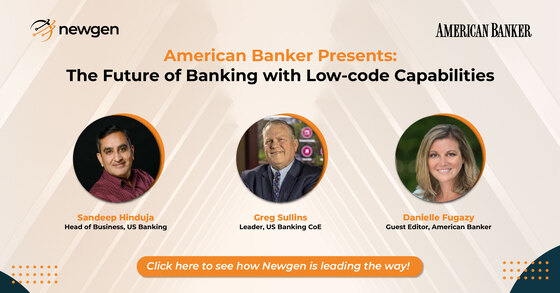
U.S. banks are operating in one of the most complex and regulated environments in the world. At the same time, customer expectations are rising, fintech competition is intensifying, and digital transformation can no longer be incremental. Sandeep Hinduja, Head of Business for US Banking at Newgen Software, spoke with American Banker about the evolution of U.S. banking, emphasizing digital transformation and the expanding influence of AI and low-code platforms. The future of banking will be characterized by agility, integrated compliance, and AI-driven customer journeys supported by an AI-first low-code platform.
The Structural Realities of U.S. Banking
The U.S. banking landscape presents unique challenges. Banks operate under a dual charter system at both the state and federal levels. Many institutions also manage international regulatory obligations. Compliance requirements such as Check 21, Dodd-Frank, HMDA updates, and the rapid rollout of PPP programs have required continuous adaptation.
At the same time, legacy mainframe systems, siloed data environments, and integration complexity limit speed and flexibility. Unlike many global markets, which have rapidly shifted to mobile-first ecosystems, U.S. banks must balance digital acceleration with continued investment in branch infrastructure and traditional customer interactions. Digital transformation in this environment requires both stability and agility.
The Role of an AI-First Low-Code Platform
rnNewgenONE is positioned as an AI-first low-code platform designed to support digital transformation across industries, with banking as one of its largest verticals in the U.S. The platform combines workflow automation, content services, communication management, and AI capabilities within a configurable architecture.
A key differentiator discussed was the move from horizontal capability to verticalized banking journeys. Instead of building from scratch, banks can leverage pre-built accelerators for use cases such as:
- Deposit account opening
- Consumer and small business loan origination
- Trade finance
- Account maintenance
Compliance is embedded in workflows through rule engines and master data management. Rather than treating regulation as a post-implementation layer, it becomes part of the process design. During regulatory shifts, such as the PPP program rollout, banks could configure and deploy updated journeys on the platform within weeks of regulatory announcements.
AI as an Inflection Point
AI represents a major shift in how banks operate. Within the NewgenONE platform, AI capabilities are embedded at the core and across banking accelerators. These include generative AI, agentic AI, and predictive models.
Use cases discussed include:
- Intelligent document processing in commercial lending
- Automatic classification and summarization of large document sets
- AI-driven assistance within digital banking channels
- Personalized product and service recommendations based on customer behavior
- Dynamic product eligibility at runtime
rnThe shift underway moves banks from static to dynamic customer segmentation. It also shifts from reactive service models to proactive engagement. AI is not positioned as an external add-on. It is embedded into the digital journeys themselves.
Moving Beyond Point Solutions
rnBanks often adopt point solutions to address immediate requirements. But sustainable transformation demands more than isolated fixes. It requires a configurable platform that evolves with regulatory shifts, rising customer expectations, and increasing competitive pressure.
Low-code enables this by accelerating time-to-market, reducing the cost of change, enabling rapid responses to regulatory updates, and supporting microservice-based extensions without requiring a full system replacement.
Strategic Priorities for Banks
Several priorities emerged from the discussion:
- Banks should actively experiment with AI while establishing clear governance frameworks. Cloud adoption remains critical for scalability and flexibility. Investment decisions should focus on platforms that enable agility and long-term adaptability rather than isolated solutions.
- Innovation pressure from fintech players will continue. The ability to configure, adapt, and deploy quickly will define competitive advantages.
- The future of U.S. banking will not be driven by isolated technology deployments. It will be shaped by intelligent, configurable platforms that embed compliance, enable AI-driven decisioning, and support unified customer and employee experiences.
In that shift from reactive to proactive banking, agility becomes the defining capability for US financial institutions.


