


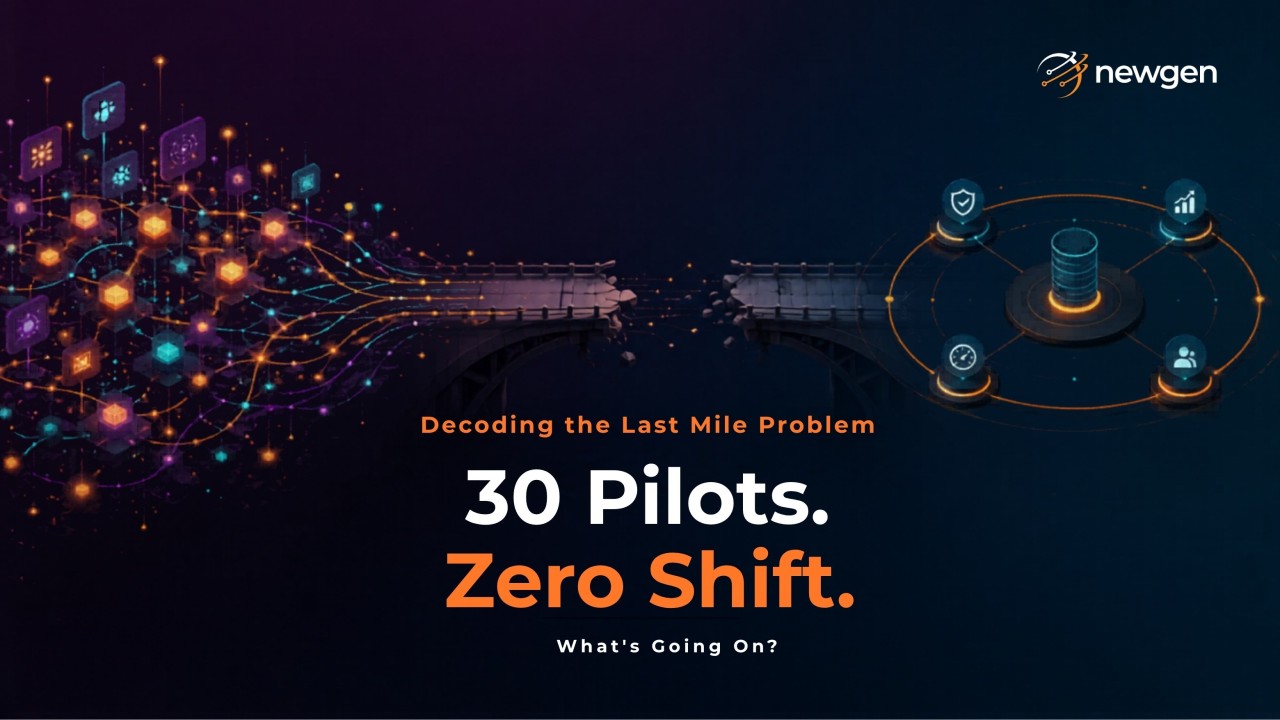
Enterprises have spent billions on AI. The dashboards look great. The demos are flawless. However, outcomes remain stubbornly missing. The culprit isn’t the AI. It never was.
Across industries, enterprise leaders are sitting with a question that rarely makes it into earnings calls or investor decks. Significant investments have gone into AI, capable systems are live, and teams are genuinely working hard, and yet, when the conversation turns candid, a familiar pattern emerges. The pilots are running, but the enterprise hasn’t moved. The instinct that follows is almost universal, double down on what got them here, more pilots, more platforms, more capabilities. The question worth asking is whether that’s the right next step.
The Mirage That Looks Like Progress
Over the last decade, banking, insurance, and government sectors have poured billions into modernizing their technology, cloud infrastructure, and more recently, agentic AI platforms. On paper, the transformation story looks compelling. However, take a closer look at any major enterprise reveals something more complicated, decisions still move through fragmented systems, manually bridged by people doing work that should, by now, be invisible.
- A bank builds a world-class credit model
- An insurer deploys a sleek claims automation tool
- A government agency digitizes citizen requests
Each of these is a genuine achievement in isolation, and that’s precisely where the problem begins. When success is measured node by node, the system as a whole never gets interrogated. What’s actually happening inside most enterprises today. The AI system does exactly what it was built to do, it predicts, flags, recommends, and decides. And, then it hits a wall. The legacy platform next door doesn’t speak its language. The compliance check exists in someone’s inbox. The customer’s full history is distributed across 3 scattered systems that were not really designed to talk to each other.

Bringing intelligence, systems, governance, people, and decisions together as one
The Part Nobody Puts in the Post-mortem
The failure lives in the connective tissue, the orchestration layer between where intelligence is generated and where the business actually acts on it. And, because it doesn’t show up cleanly on a dashboard, it rarely gets the attention it deserves.
- A risk model delivers a recommendation in seconds. The approval takes 4 days because document verification sits in a disconnected legacy system
- Claims automation goes live and works beautifully, until it hits a complex case where communication history is trapped in a silo no one mapped during implementation
- Citizen requests are digitized at the front end, but resolutions still travel through email chains because nobody wired the intake system to the back-office workflow
The AI is doing its job. Everything around it is being held together by people filling gaps that technology should have closed.
The Gap Nobody Sees Until It’s Too Late
The orchestration gap is the distance between where AI makes a decision and where the business acts on it, and in most enterprises, that distance is longer, slower, and riskier than anyone has formally acknowledged. It doesn’t make for a compelling keynote slide. It isn’t the feature that wins a procurement decision. But it is quietly responsible for the majority of AI ROI that enterprises expected and never received.
As AI systems move toward greater autonomy, an agent operating without full context, without visibility into regulatory requirements, customer history, or organizational risk appetite, isn’t just inefficient. In an increasingly unforgiving compliance environment, it becomes a liability. Autonomy without orchestration isn’t a capability upgrade. It’s a new category of risk instead.

Turning Complex Workflows into a Competitive Advantage
The Ones Getting it Right Aren’t Launching More, They are Connecting More
The enterprises seeing returns from their AI investments share one distinguishing characteristic, they stopped treating AI as a tool to be added to existing workflows and started treating it as the system itself. Intelligence wired into the flow of work, not sitting beside it. Governance designed in from the start, not appended as a checkpoint.
These organizations have shifted the question they ask internally. Not ‘how do we deploy more AI?’ but ‘how do we make the AI we already have show up in outcomes?’ The enterprises pulling ahead are not the ones with the most AI. They are the ones making it work.
What This Means for Leadership
- If AI pilots aren’t scaling, the answer is rarely more pilots. Audit the handoffs between systems, that’s almost certainly where the value is leaking
- Orchestration is not an IT workstream. It is a strategic priority that belongs in the same conversation as AI investment itself
- The metric that makes a big-time difference is not how many AI tools are running. It is how many AI-driven decisions are reaching outcomes without a human workaround in the middle
- Governance designed after deployment is governance that will fail. The regulatory environment is moving too fast for reactive approaches.
The future belongs to enterprises that don’t just build intelligence but make it operational, at scale, by design.


