
NewgenONE Platform
AI-powered Document Management System
Leverage AI-powered document management system for secure, scalable enterprise content management, enabling intelligent capture, seamless integration, lifecycle automation, and advanced search for efficient digital operations.
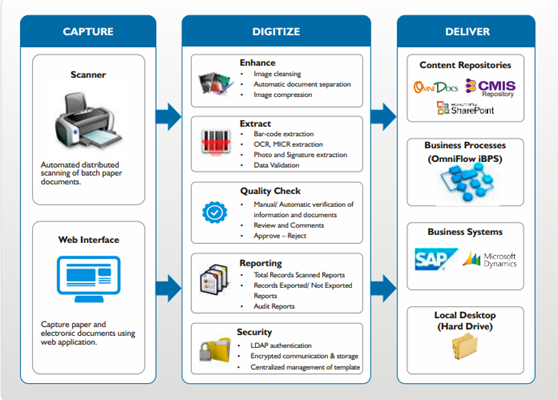
A document management system (DMS) enables organizations to store, manage, and retrieve all organizational content and is a good fit for small-sized organizations. On the other hand, enterprise content management (ECM) software can offer all that a document management system (DMS) has to offer and more! And it is ideally suited for large enterprises as it goes beyond storage and offers capabilities like content capture, business process management(BPM), and long-term archival. It enables organizations to completely digitize their operations while effectively managing content.
A document management system can be considered appropriate for a department in an organization for its content storage and retrieval requirements. But from an organization-wide perspective, an enterprise content management solution is the go-to option where critical decisions are based on content, and you have to digitize large and complex business workflows and connect many applications and repositories.
NewgenONE Contextual Content Services Platform can be used for creating, capturing, managing, delivering, and archiving large volumes of documents. NewgenONE provides a highly scalable, unified repository for securely storing and managing enterprise content. It provides access to enterprise content directly and through integration with business applications. It also offers a centralized repository for enterprise documents and supports rights-based archival.
NewgenONE enterprise document management system supports both centralized and distributed scanning with policy-based upload. Manages the complete lifecycle of documents through record retention, storage, and retrieval policies. Supports exhaustive document and folder searches on date, indexes, and general parameters as well as full-text search on image and electronic documents.
Features of Newgen Document Management System
Centralized storage
Newgen’s enterprise document management system provides a cloud-based centralized repository that makes it easier for organizations to digitally store documents in standardized file structures and formats. Allows easy management, access, and retrieval of documents as and when required
Version control and auditability
Newgen’s document management solution enables users to keep track of changes that are being made to documents and leaves audit trails, permitting the reconstruction of actions taken on documents by individuals
Approval Workflows
Newgen’s document management system uses AI to route documents from one person to another through built-in content-centric linear workflow capabilities for quick approvals and reviews.
Security and access control
Newgen’s document management system provides an extra layer of control through granular access to documents. Stringent security policies and role-based access control prevent unauthorized users from accessing sensitive documents
Easy search and retrieval with Gen-AI
Electronic DMS allows easy search and retrieval of documents through intuitive search capabilities and prompt-based search capabilities through GenAI.
Disaster recovery
Any good DMS will have a disaster recovery plan. Digitally archived paper documents are protected from any disasters. Documents stored in a DMS cannot be lost or misfiled and can be easily located with cross-indexing.
Indexing
Newgen’s enterprise document management system uses GenAI to assign metadata to documents for easy storage and retrieval.
Lead with an Industry-recognized Platform


Organizations looking for an advanced content platform capable of scaling for heavy workloads and that need deployment flexibility and advanced automation and AI capabilities should consider Newgen.
The Forrester Wave™: Content Platforms, Q1 2025

Customers









Customer Speak


Chief Retail Banking Officer
Bank Dhofar

SVP & Head of Information Technology
Housing Bank

Chief Compliance Officer
Vision Bank

Chief Technology Officer
Vision Bank
Real Outcomes Across Industries
















All you need to know about Document Management System
A Document Management System (DMS) digitally stores, organizes, and secures documents in a central repository. It enables fast search, controlled access, versioning, audit trails, and automated workflows, helping organizations manage information efficiently and reduce reliance on manual, paper-based processes.
A DMS software captures, indexes, stores, and retrieves documents using metadata and search tools. It automates workflows, applies access controls, tracks versions, and ensures documents move through approvals and processes efficiently, improving accuracy, compliance, and operational productivity.
Document management ensures documents are securely stored, easily accessed, and consistently organized. It reduces manual handling, supports collaboration, improves accuracy, maintains compliance, and speeds up business processes across departments that depend on fast, reliable access to information.
A Document Management System (DMS) improves efficiency, centralizes information, reduces errors, enhances collaboration, strengthens security, supports compliance, and lowers storage costs. It enables quick document retrieval, automated workflows, and standardized processes that help teams work faster and more consistently.
Key features of Document Management Software (DMS) include secure storage, metadata-based search, version control, audit logs, access controls, workflow automation, document capture, integrations, mobile access, and compliance tools. These capabilities help organizations manage documents accurately, securely, and efficiently.
A Document Management System (DMS) supports contracts, invoices, forms, HR files, emails, policies, proposals, reports, images, scanned documents, customer records, and operational documents. It handles structured and unstructured content, ensuring everything is searchable, secure, and easy to retrieve.
A Document Management Solution (DMS) automates routing, approvals, notifications, and document-centric tasks. It reduces manual effort, accelerates processing times, minimizes errors, and ensures teams follow standardized workflows. This improves turnaround, productivity, and overall process consistency.
A DMS protects information through encryption, role-based permissions, audit trails, version control, and secure authentication. It ensures only authorized users access sensitive documents, helping organizations safeguard data, prevent breaches, and maintain policy and regulatory compliance.
A DMS enforces retention policies, maintains complete audit trails, supports version control, secures documents, and ensures consistent handling. It simplifies audits, reduces compliance risk, and helps organizations meet industry regulations with documented, traceable processes.
A DMS manages day-to-day documents; ECM manages enterprise-wide content, workflows, and governance; Records Management handles long-term preservation and retention. Together, they support content lifecycle management, from creation to archival, across the organization.
Yes. Cloud-based DMS platforms use encryption, access controls, backups, monitoring, and compliance certifications (ISO, SOC, GDPR). They offer secure access from anywhere, strong data protection, and built-in redundancy, often exceeding the security of on-premises systems.
Most modern DMS platforms integrate via APIs, connectors, and web services. This enables automatic document creation, real-time data exchange, workflow triggers, centralized access, and seamless use across CRM, ERP, and industry-specific systems.
AI automates document classification, data extraction, tagging, and search. It identifies patterns, validates information, recommends actions, and speeds up document-centric workflows. Automation reduces manual effort, improves accuracy, and accelerates processing times.
Industries like banking, insurance, healthcare, manufacturing, government, legal, education, and retail rely on DMS for handling sensitive documents, compliance requirements, large-scale transactions, and high-volume information processes that demand accuracy and speed.
A DMS provides secure, cloud-based access, mobile support, version control, and real-time collaboration. Remote teams can retrieve, edit, approve, and share documents without delays, ensuring consistent productivity regardless of location.
Challenges include change resistance, inconsistent document structures, data migration complexity, integration needs, and user training. Clear governance, standardized processes, and strong onboarding help ensure successful adoption and long-term value.
Document workflow management automates how documents move across tasks—review, approval, routing, storage, and distribution. It ensures standardized processing, faster turnaround, fewer errors, and full visibility into document-centric processes.
Document automation uses templates, rules, and data to generate documents automatically. When combined with a DMS, it streamlines creation, routing, approval, storage, and delivery—reducing manual effort and improving consistency.
Costs vary based on user count, storage needs, deployment type, integrations, and features. Cloud DMS typically uses subscription pricing, while on-premise may require higher upfront investment. ROI comes from reduced storage, faster workflows, and improved compliance.
Organizations should evaluate scalability, security, ease of use, compliance features, integration capabilities, automation tools, AI readiness, deployment flexibility, and vendor reliability. The best DMS adapts to changing business needs and supports enterprise-wide information governance.
Current DMS trends include AI-driven document classification, automated metadata tagging, cloud-native deployment, mobile document access, integration with workflow and collaboration tools, enhanced security, advanced search capabilities, e-signatures, low-code customization, and stronger compliance support across distributed and hybrid work environments.
Common challenges include poor document organization, legacy system migration issues, inconsistent naming conventions, low user adoption, integration complexity, and unclear governance policies. Successful implementation requires strong training, standardized structures, clean data, and clear ownership to ensure long-term value.
