




Why Are Governments Rethinking Records Management in the Digital Age?
Every government’s credibility rests on its records, the files, decisions, and communications that define accountability. But as information expands across paper archives, emails, and digital systems, managing it has become increasingly complex.
Manual filing, fragmented repositories, and outdated systems make retrieval slow and compliance risky. In an era where citizens expect transparency, traceability, and accountability and regulators demand audit readiness, traditional recordkeeping can no longer keep pace.
That’s why governments are shifting from storage-centric systems to intelligent records management software (RMS), ones that unify physical and digital archives, enforce compliance automatically, and protect sensitive data through modern security frameworks.
The question now isn’t whether to modernize, but how to choose a solution that can scale securely, meet evolving regulations, and strengthen public trust.
What Challenges Do Government Agencies Face with Legacy Record Systems?
Despite large-scale digitization drives, many public institutions still rely on outdated document systems designed decades ago. These systems were never built for today’s scale, security expectations, or compliance complexity.
Here’s where the cracks show:
- Fragmented Repositories: Physical and electronic records sit in silos, making it hard to maintain a single version of truth.
- Slow Retrieval: Locating a document for audit or citizen query can take hours, sometimes days.
- Manual Handling: Classification, retention, and archival are often done manually, increasing risk of errors and non-compliance.
- Limited Visibility: Without dashboards or automated reports, tracking record movements or policy adherence becomes guesswork.
- Compliance Gaps: Many systems lack audit trails, encryption, or retention controls required under frameworks like ISO 15489 or DoD 5015.2.
- Integration Barriers: Outdated architectures struggle to connect with modern tools like Microsoft 365, SharePoint, or ERP systems.
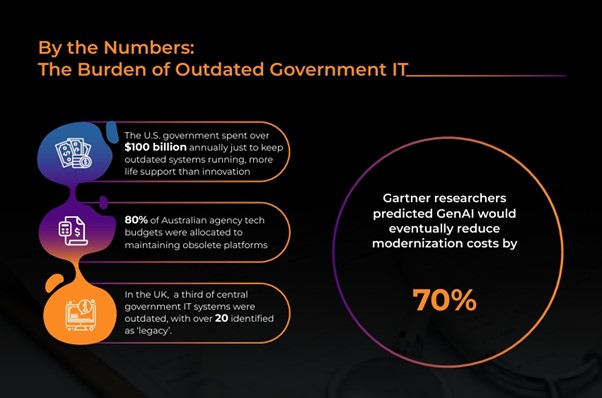
*Source: NewgenONE Records Management System Instilling Digital Trust in the Age of AI
The impact goes beyond inefficiency, it affects citizen trust, audit readiness, and policy execution. Therefore, modernizing records management becomes a governance imperative.
What is an AI-first Records Management System?
A modern, AI-first records management system introduces intelligence and automation into every stage of the record’s lifecycle. Instead of merely storing information, it understands, recognizing context, applying policies, and enforcing governance without constant human oversight.
AI-first systems use technologies such as natural language processing (NLP) and machine learning (ML) to classify documents, extract metadata, and recommend actions in real time. For example, they can identify which documents relate to a particular citizen case, determine their retention period, or automatically flag records that require restricted access.
This intelligence transforms how governments work. It allows teams to search conversationally (“show all permits approved last quarter”), automate retention schedules, and gain visibility into records across departments. Most importantly, it ensures consistency, the same policies, applied across the board, without manual intervention.
AI-first recordkeeping helps governments focus less on managing files and more on managing outcomes, faster audits, secure collaboration, and compliance built into every action.
What Should You Look for in a Government Records Management Solution?
Selecting the right system goes beyond checking feature lists. It’s about choosing a platform that can uphold the principles of public governance, transparency, accountability, and resilience, while remaining practical to deploy and scale.
Here are the key dimensions that matter most:
- Records Lifecycle Management
The system must manage the complete journey of a record, from creation and classification to archival and final disposition. Automation should handle retention schedules, disposal approvals, and policy enforcement, ensuring that every record follows a verifiable path. - Compliance Alignment
Governments operate under complex mandates: DoD 5015.2, ISO 15489, ISO 16175, VERS, IM4L, and regional archival standards. The system should come with built-in frameworks for these certifications and allow configuration for country-specific requirements. - Security and Governance Controls
Security must be embedded, not added later. Look for features such as encryption (in transit and at rest), multi-factor authentication, digital signatures, and watermarking. Immutable audit trails and legal holds ensure data integrity even during investigations or litigations. - Intelligence and Automation
AI-driven classification and metadata extraction reduce human dependency. Dashboards that track record status, retention, and access bring real-time transparency. NLP-based search helps users find the right document without complex queries. - Integration and Scalability
An effective RMS should integrate with your existing environment, Microsoft 365, Outlook, SharePoint, SAP, or core line-of-business applications. It must also support structured data archival from systems like SQL or Oracle and scale across hybrid or multi-cloud setups. - Usability and Oversight
Adoption depends on usability. The solution should offer intuitive dashboards, role-based views, and configurable reports for record managers and administrators alike.
The right RMS doesn’t just meet compliance requirements, it simplifies them, embedding governance into daily operations instead of enforcing it through rigid procedures.
How Can Governments Evaluate RMS Vendors Effectively?
Modernizing records management requires more than technology; it needs alignment between people, processes, and platforms. A structured evaluation framework helps agencies make decisions confidently.
Step 1: Assess Current Maturity
Begin by mapping your existing record landscape. Identify where duplication, delay, or non-compliance occurs. Understanding the current pain points clarifies what the new system must solve.
Step 2: Define Regulatory and Functional Scope
List every applicable standard and compliance requirement. This defines your baseline for vendor qualification and avoids expensive reconfiguration later.
Step 3: Prioritize Integration
A system that cannot talk to your existing applications will create new silos. Check for out-of-the-box connectors, REST/SOAP APIs, and compatibility with productivity tools.
Step 4: Conduct a Proof of Concept (PoC)
Run a controlled pilot to evaluate performance under real-world conditions. Measure classification accuracy, migration reliability, and search precision. The PoC phase also helps gauge user adoption and ease of configuration.
Step 5: Plan Data Migration with Care
Legacy data migration is often underestimated. Look for vendors that provide automated tools for metadata mapping, validation checks, and seamless transfer without data corruption. Maintaining lineage between old and new repositories ensures audit continuity.
Choosing a vendor isn’t about who offers the most features, it’s about who understands the nuances of governance, compliance, and scalability in the public sector context.
What Outcomes Should an Intelligent RMS Deliver?
When records management works as it should, its benefits ripple across the entire organization. A modern RMS delivers tangible improvements that go beyond process efficiency:
- Faster Access and Retrieval: Search results in seconds, not hours, supporting quicker citizen response and audit preparation.
- Improved Data Security: Layered authentication, encryption, and immutable logs protect sensitive information and maintain confidentiality.
- Regulatory Confidence: Automated retention, classification, and audit readiness ensure that agencies stay compliant effortlessly.
- Cost Efficiency: Cloud-native architectures reduce infrastructure overhead and maintenance costs.
- Resilience and Continuity: Automated backup, disaster recovery, and secure email archiving safeguard information through disruptions.
- Workforce Productivity: AI-assisted workflows reduce manual tasks, letting employees focus on service delivery instead of document handling.
These outcomes collectively reinforce digital trust, the assurance that government systems not only function efficiently but also protect citizens’ information with diligence and accountability.
How is AI Redefining the Future of Government Recordkeeping?
AI is reshaping records management from passive storage to active intelligence. The next wave of government RMS solutions will use predictive algorithms to make recordkeeping adaptive and self-governing.
Imagine a system that automatically recommends when to archive a record based on its relevance or policy changes; one that flags potential non-compliance before it happens; or one that allows officers to query data conversationally, “Show me all contracts due for renewal next quarter.”
These capabilities are already emerging through generative AI (GenAI), natural language search, and contextual summarization. In fact, Gartner researchers predict GenAI would eventually reduce modernization cost by 70%. Combined with low-code configurability, agencies can update record policies or workflows instantly, without vendor dependency.
The future RMS will act as an advisor, not just storing records but helping interpret them, connecting patterns, and enabling proactive decision-making. This is the essence of intelligent governance.
Why Governments Are Moving Toward Unified Platform-based Records Management
Government recordkeeping works best when systems talk to each other. A unified platform brings content, process automation, and compliance together in one environment, creating a single digital backbone for governance.
This model delivers lasting advantages:
- Centralized governance: Policies, retention rules, and access controls remain consistent across every department and repository.
- Agility in change: Low-code configuration lets teams adapt workflows or retention policies quickly, without waiting for major IT intervention.
- Complete visibility: Unified dashboards present a real-time view of records across departments, helping administrators spot gaps or risks instantly.
- Scalable foundation: The same platform can evolve with emerging technologies and new compliance frameworks, ensuring continuity without large reinvestments.
As policies, data types, and citizen expectations continue to evolve, a platform-based approach ensures modernization is not a one-time initiative but an ongoing capability.
How NewgenONE Records Management System is Empowering Government Agencies
Across governments, recordkeeping is evolving from a routine administrative function to a strategic pillar of digital governance. What agencies need today is not another repository, but a system that can intelligently govern information, wherever it resides.
NewgenONE Records Management System (RMS) is designed for that environment. It brings together content services, automation, and compliance in one unified platform, allowing public institutions to manage information intelligently through its entire lifecycle, from creation to preservation.
The system gives administrators and records officers complete control and visibility.
- End-to-end lifecycle management: Every record, physical or digital, is captured, classified, and retained according to policy. Disposition and archival activities are fully traceable.
- Compliance readiness: The platform is aligned with global and regional standards including DoD 5015.2, ISO 15489, ISO 16175, VERS, IM4L, and NRAA Oman, ensuring audit readiness at all times.
- Security built-in: Encryption, digital signatures, role-based access, and immutable audit trails maintain authenticity and protect sensitive data.
- AI-assisted intelligence: Machine learning helps classify content, extract metadata, and automate retention schedules, reducing manual effort and improving accuracy.
- Integration and scalability: The platform connects seamlessly with Microsoft 365, SharePoint, Outlook, SAP, and other enterprise applications. Built on a low-code, cloud-ready architecture, it scales easily across departments and jurisdictions.
By bringing structure to unstructured information, NewgenONE RMS helps governments maintain compliance, accelerate audits, and strengthen citizen trust. Built on a low-code, cloud-ready architecture, NewgenONE RMS gives governments the flexibility to adapt, to new mandates, new technologies, and new scales of operation, without disrupting ongoing work.
Conclusion
Choosing the right records management software is ultimately about aligning technology with governance priorities. The right system doesn’t just digitize archives, it defines how information is governed, protected, and used to make decisions.
When evaluating solutions, governments should focus on a few fundamentals: compliance that adapts to changing regulations, scalability that supports long-term modernization, and intelligence that reduces manual dependency without compromising control. The goal is not to buy software, but to build resilience, system capable of sustaining transparency and trust through every policy cycle.
FAQS
1. What is NewgenONE Records Management System (RMS)?
NewgenONE RMS is an enterprise-grade solution that enables government organizations to manage both physical and electronic records across their entire lifecycle, from creation and capture to retention, archival, and disposal. It helps maintain compliance, strengthen security, and ensure traceability through a unified, AI-driven platform.
2. How does NewgenONE RMS support government compliance mandates?
NewgenONE RMS aligns with international and regional standards such as DoD 5015.2, ISO 15489, ISO 16175, VERS, IM4L, IM8, and NRAA Oman. It provides configurable policy templates, automated retention schedules, and audit-ready trails that help agencies meet local and global regulatory requirements efficiently.
3. What role does AI play in NewgenONE RMS?
AI enhances every aspect of record management, from intelligent classification and metadata tagging to automated policy enforcement and predictive retention. NewgenONE RMS uses natural language processing and machine learning to make records searchable, contextual, and compliant without manual intervention.
4. How does NewgenONE RMS integrate with existing government systems?
The platform offers out-of-the-box integrations with commonly used tools such as Microsoft 365, SharePoint, Outlook, and SAP. It also supports REST/SOAP APIs for interoperability with ERP, CRM, or legacy applications, ensuring seamless flow of information across government departments and repositories.
5. How does NewgenONE RMS ensure security and data integrity?
NewgenONE RMS incorporates multi-layered security, including role-based access, multi-factor authentication, encryption (in transit and at rest), and digital signatures. Immutable audit logs and legal hold features ensure every record remains authentic and tamper-proof throughout its lifecycle.
6. Can NewgenONE RMS handle both physical and electronic records?
Yes. Newgen’s RMS is designed to manage hybrid environments, enabling governments to digitize physical archives while managing electronic records in the same platform. It supports barcoding, consignment tracking, and physical record movements alongside digital workflows for complete visibility and control.
7. What makes NewgenONE RMS scalable for large government ecosystems?
Built on a low-code, cloud-based architecture, NewgenONE RMS supports on-prem, hybrid, and multi-cloud deployments. Its modular design ensures scalability across agencies and jurisdictions, allowing governments to expand seamlessly as data volumes and compliance needs grow.
8. How does NewgenONE RMS improve audit readiness and transparency?
The system automatically maintains immutable audit trails, records every action, and generates detailed reports for compliance checks. With centralized dashboards and AI-driven analytics, NewgenONE RMS helps agencies demonstrate accountability and maintain transparency in recordkeeping.
9. How does NewgenONE RMS contribute to operational efficiency?
By automating classification, retrieval, and retention, NewgenONE RMS reduces manual effort and speeds up information access. Employees spend less time searching for files and more time on decision-making and citizen service delivery, resulting in measurable productivity gains.
10. Why do governments choose NewgenONE RMS?
Governments choose NewgenONE RMS for its proven ability to combine compliance, security, automation, and scalability in one platform. With decades of experience in digital governance, Newgen helps agencies modernize recordkeeping, accelerate audits, and build digital trust among citizens.
You might be interested in

02 Jan, 2026
The Trust Layer of BFSI: Enterprise Content Management for Continuous Compliance and Operational Resilience
31 Dec, 2025
Newgen Recognized in Forrester’s The Accounts Payable Invoice Automation Software Landscape, Q4 2025
